Golden Plates
Book of MormonThe Golden Plates are the material foundation and narrative hinge of The Book of Mormon. They are presented not merely as an ancient artifact but as a preserved record whose survival, concealment, translation, and public testimony connect vanished peoples with later readers. The plates contain engravings concerning the Nephites and Lamanites, include an abridgment of the Jaredite record, and are described as having been sealed and hidden unto the Lord so that they would not be destroyed and could come forth through the gift and power of God in due time.
Definition and Intended Record
The title material identifies the work as an abridgment taken from the plates of Nephi. Its intended audiences include the Lamanites, described as a remnant of the house of Israel, as well as Jew and Gentile. The plates therefore function as a layered archive rather than a single personal memoir: they preserve the history of the people of Nephi and the Lamanites, while the book also incorporates an abridgment from the record of the Jaredites, an earlier people scattered when the Lord confounded the language of those building a tower to get to heaven.
The stated purpose of this preserved record is both historical and covenantal. It is meant to show the remnant of the house of Israel what the Lord did for their fathers and to help them know the covenants of the Lord, including the assurance that they are not cast off forever. At the same time, the record is directed toward convincing Jew and Gentile that Jesus Christ is the Eternal God manifesting himself unto all nations. The plates thus carry ancestral memory, prophetic interpretation, and a claim about the identity and universal manifestation of Jesus Christ.
Concealment, Custody, and Future Emergence
The record associated with the Golden Plates is described as written and sealed, then hidden unto the Lord for protection. Its concealment gives the object a double status: it is physically inaccessible for a period, yet narratively active because its promised future appearance shapes the book’s entire frame. The record is not said to emerge through ordinary discovery alone; it is to come forth by the gift and power of God and through the way of the Gentile, in due time.
Moroni becomes the decisive custodian at the end of the Nephite record. He identifies himself as the son of Mormon and a descendant of Nephi, and states that he is the same person who hides up the record unto the Lord. His statement separates the worth of the plates as precious metal from their higher value as an object preserved by commandment. The plates matter because they carry a commanded record, not because they can be possessed for material gain. Moroni’s concealment therefore completes a chain of stewardship that begins with earlier record keepers and extends toward a future audience beyond his own ruined civilization.
Witnesses and Physical Encounter
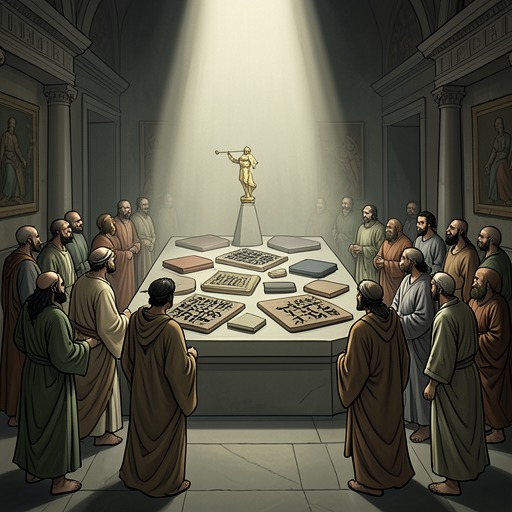
The Golden Plates receive two distinct forms of human testimony. Three Witnesses declare that they saw the plates containing the record of the Nephites, Lamanites, and Jaredites. Their testimony distinguishes seeing the plates from merely hearing about them: they report that an angel of God came down from heaven, brought the plates before their eyes, and enabled them to behold both the plates and the engravings. They also state that the translation had occurred by the gift and power of God, with the Lord’s voice declaring the work to them.
The Three Witnesses frame their experience as an obligation rather than a private marvel. They say that the voice of the Lord commanded them to bear record, and they present their testimony to all nations, kindreds, tongues, and people. Their reliability is grounded in a shared encounter, divine command, and public declaration. They also connect faithful testimony with being found spotless before the judgment-seat of Christ, placing the evidentiary role of the plates inside a religious and moral framework.
The Eight Witnesses offer a different kind of confirmation. Joseph Smith showed them the plates, which they describe as having the appearance of gold. They report handling as many leaves as had been translated, seeing the engravings, and recognizing an appearance of ancient work and curious workmanship. Their testimony emphasizes bodily contact: they saw, handled, and hefted the plates, and declared that they were not lying, with God bearing witness of their statement. In contrast with the Three Witnesses’ angelic encounter, the Eight Witnesses’ account stresses direct physical examination by a larger group.
Together, these testimonies create a deliberate movement from individual custody to collective knowledge. The plates are at once a concealed sacred trust, an object shown by divine intervention, and a tangible artifact handled by witnesses. The narrative does not treat these modes of access as interchangeable. It preserves the distinction between revelation, angelic presentation, written record, and touch, making the authority of the Golden Plates depend on a convergence of material and spiritual forms of testimony.
Narrative Transmission and Editorial Form
The Golden Plates also explain why The Book of Mormon repeatedly foregrounds records, abridgment, translation, and selective narration. Nephi explicitly says that he does not make a full account of what his father, Lehi, wrote, because Lehi had recorded many things seen in visions and dreams. This admission establishes that the surviving narrative is shaped by selection: earlier records exist, but a later writer chooses what to include. The plates consequently signify not an untouched transcript of history but a material medium through which several generations of record keepers preserve, compress, and interpret the past.
The book’s opening frame makes the editorial process part of the object’s meaning. A record taken from the plates of Nephi is joined to an abridgment taken from the Book of Ether, so the Golden Plates represent a repository in which distinct peoples and historical periods are brought into a single commanded work. The resulting text carries traces of multiple narrators and records while presenting them as a unified witness to divine action, covenant continuity, and the mission of Jesus Christ.
Their importance continues beyond the history of their first peoples. Nephi writes that his soul delights in the scriptures engraved upon the plates of brass and that his heart ponders them, showing how inscribed records nourish interpretation rather than merely preserve data. Moroni likewise warns readers not to condemn the record because of its imperfections, promising that those who receive it without such condemnation may know greater things. The physical plates therefore stand behind a text that openly acknowledges human limitation while directing readers toward spiritual knowledge.
Fulfillment Through Translation and Revelation
The Golden Plates become the source from which the record is translated, but the book attributes the intelligibility of that translation to divine gift and power. The Three Witnesses specifically affirm that the work was translated in this manner, and the title material likewise says that the interpretation of the plates would come through the gift of God. Translation is thus presented as a second stage of preservation: the record survives materially, then becomes available through an inspired interpretive process.
The plates’ significance is finally measured by what their record reveals rather than by their appearance alone. Their contents point readers toward the covenants of the Lord, the history and scattering of the Jaredites, and the declaration that Jesus Christ is the Eternal God. The narrative reaches beyond the artifact’s hidden location and beyond the original communities who produced its records. By passing from engraved plates to translated scripture, the object turns historical survival into an invitation to remember, recognize covenant obligations, and receive a testimony of Jesus Christ.